
 By Bapi Mondal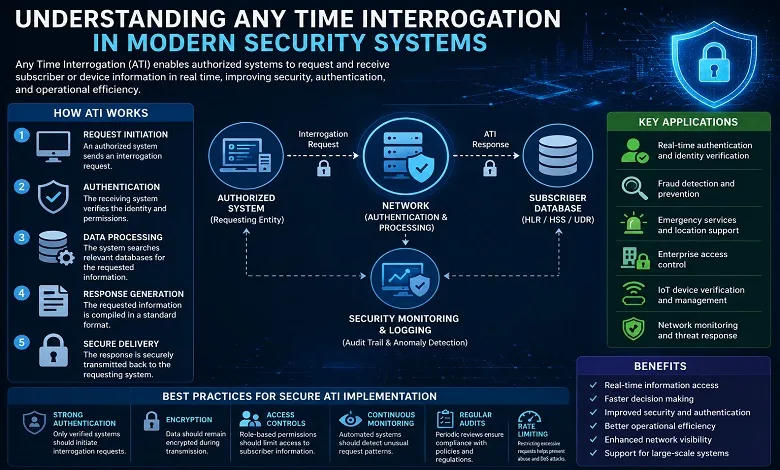
Modern security systems rely on speed, accuracy, and continuous communication between devices and networks. Whether it is a mobile network checking subscriber information, an access control system verifying credentials, or an enterprise security platform monitoring activity, instant data retrieval is essential. This is where Any Time Interrogation (ATI) becomes an important concept.
Understanding Any Time Interrogation in modern security systems helps organizations appreciate how real-time information requests improve efficiency, strengthen authentication processes, and support secure communication. ATI allows authorized systems to retrieve critical data whenever it is needed rather than waiting for scheduled updates or manual intervention.
As digital infrastructure continues to evolve, Any Time Interrogation plays an increasingly significant role in telecommunications, cybersecurity, and identity verification. This article explores what ATI is, how it works, its applications, benefits, challenges, and future trends.
Any Time Interrogation, often abbreviated as ATI, is a network procedure that allows an authorized entity to request subscriber or device information at any moment. The process is commonly associated with mobile telecommunications, where network components need immediate access to location data or subscriber status.
Unlike periodic synchronization methods, ATI provides on-demand access to information. When a request is initiated, the target system processes the query and returns the required details if the requester has the necessary permissions.
The concept supports real-time decision-making and helps maintain smooth communication between different parts of a security or telecommunications infrastructure.
Organizations depend on timely information to make security decisions. Delays in retrieving user or device information can affect authentication, fraud detection, and emergency response.
Understanding Any Time Interrogation in modern security systems is important because it enables:
- Instant verification of subscriber information.
- Improved network management.
- Faster security responses.
- Better service availability.
- Enhanced operational efficiency.
As networks become larger and more interconnected, ATI supports reliable communication between multiple systems without significant delays.
The ATI process follows a structured sequence.
Step 1: Request Initiation
An authorized system sends an interrogation request asking for specific subscriber or device information.
Step 2: Authentication
The receiving network verifies whether the requesting entity has permission to access the requested data.
Step 3: Data Processing
After successful authentication, the network searches its databases for the requested information.
Step 4: Response Generation
The requested information is compiled into a standardized response.
Step 5: Secure Delivery
The response is securely transmitted back to the requesting system.
This entire sequence often occurs within seconds, making ATI highly valuable for real-time operations.
Several network elements participate in Any Time Interrogation.
Subscriber Database: Stores user identities, service information, and subscription details.
Authentication Server: Verifies permissions before allowing access.
Communication Gateway: Transfers requests between different systems securely.
Security Monitoring Platform: Analyzes incoming requests and detects unusual activity.
Logging System
Maintains records of interrogation requests for auditing and compliance purposes.
Together, these components ensure that ATI operates efficiently while maintaining security controls.
ATI has numerous practical applications across industries.
Mobile Telecommunications
Telecom operators use ATI to obtain subscriber location and status information needed for network services and roaming support.
Emergency Services
Emergency responders may require immediate location-related information to assist quickly.
Fraud Detection
Financial institutions and service providers can verify user activity patterns and identify suspicious behaviour in near real time.
Enterprise Security
Organizations use ATI-like mechanisms to validate employee credentials and device identities before granting network access.
Internet of Things (IoT)
Connected devices frequently exchange authentication information, making on-demand interrogation useful for maintaining secure communication.
Smart Cities
Traffic systems, surveillance networks, and public infrastructure can rely on instant data retrieval to coordinate operations efficiently.
Faster Decision Making: Immediate access to information allows administrators to respond quickly to security incidents.
Improved Authentication: Real-time verification reduces the likelihood of unauthorized access.
Enhanced Operational Efficiency: Automated interrogation minimizes manual data retrieval and improves workflow.
Better User Experience: Users experience fewer delays during authentication and service delivery.
Increased Network Visibility: Security teams gain better insight into system activity through continuous monitoring.
Support for Large-Scale Networks: ATI enables organizations to manage millions of users without requiring constant manual updates.
Security Advantages of ATI: Properly implemented ATI strengthens multiple layers of security.
Real-Time Identity Verification: Users and devices can be verified instantly before services are granted.
Continuous Monitoring: Security teams receive up-to-date information rather than relying on outdated records.
Rapid Incident Response: Suspicious activities can trigger immediate investigations.
Improved Audit Trails: Every interrogation request can be logged, providing accountability and compliance documentation.
Better Access Control: Only authorized entities receive requested information, reducing unnecessary exposure.
Although ATI provides numerous benefits, several challenges must be manage carefully.
Privacy Concerns
Subscriber information should only be accesse by authorize systems and for legitimate purposes.
Unauthorized Requests
Weak authentication mechanisms could allow attackers to request sensitive information.
High Traffic Volume
Large numbers of simultaneous requests may place a significant load on the network infrastructure.
Data Accuracy
Incorrect or outdated records reduce the usefulness of ATI responses.
Regulatory Compliance
Organizations must follow local and international privacy regulations when handling subscriber data.
To maximize the security of Any Time Interrogation (ATI) systems, organizations should adopt a comprehensive approach that includes multiple protective measures. Strong authentication mechanisms should ensure that only verified and trusted systems can initiate interrogation requests, while encryption should safeguard all data during transmission to prevent unauthorized interception. Role-based access controls should be implemented to restrict subscriber information to authorized personnel only, reducing the risk of internal misuse. Continuous monitoring tools can automatically detect unusual request patterns and potential security threats in real time, allowing for faster incident response. In addition, regular security audits help verify compliance with organizational policies and regulatory requirements, ensuring that vulnerabilities are identified and addressed promptly. Finally, rate limiting should be enforced to prevent excessive requests, minimizing the risk of abuse, system overload, and denial-of-service attacks.
Cybersecurity teams increasingly depend on instant access to network information.
ATI contributes by:
- Supporting rapid incident investigations.
- Verifying user identities.
- Identifying compromised accounts.
- Detecting unauthorized devices.
- Strengthening zero-trust security architectures.
As organizations adopt more cloud-based services, ATI concepts continue to support adaptive security models.
Mobile communication systems frequently require subscriber information for routing and service delivery.
ATI enables operators to:
- Determine subscriber availability.
- Retrieve location-related information.
- Support roaming services.
- Verify subscription status.
- Improve call routing efficiency.
These capabilities help maintain uninterrupted communication across national and international networks.
Several technological developments will shape ATI in the coming years.
Artificial Intelligence Integration: AI-powered analytics can detect suspicious interrogation patterns automatically.
Machine Learning: Behavior analysis may identify abnormal requests before security incidents occur.
5G and Beyond: High-speed networks require even faster data retrieval mechanisms, increasing the importance of ATI.
Zero Trust Architecture: Future security frameworks will continuously verify identities through real-time interrogation.
Cloud-Native Security: Distributed cloud environments will increasingly depend on on-demand verification systems.
Automation: Security orchestration platforms will integrate ATI into automated incident response workflows.
| Feature | Any Time Interrogation | Traditional Retrieval |
| Data Access | On-demand | Scheduled |
| Speed | Real-time | Delayed |
| Automation | High | Moderate |
| Security Response | Immediate | Slower |
| Operational Flexibility | Excellent | Limited |
| Monitoring | Continuous | Periodic |
This comparison highlights why ATI is valuable in environments requiring rapid access to accurate information.
ATI Is Only Used in Telecom
Although telecommunications heavily utilize ATI, similar concepts appear in cybersecurity, IoT, enterprise authentication, and smart infrastructure.
ATI Automatically Compromises Privacy
When implemented correctly with authentication, encryption, and auditing, ATI can operate while respecting privacy requirements.
ATI Eliminates Human Oversight
Automation assists administrators, but human monitoring remains essential for policy enforcement and incident investigation.
ATI Is Difficult to Deploy
Modern platforms often include standardized protocols and APIs that simplify integration.
Understanding Any Time Interrogation in modern security systems is essential for organizations seeking efficient, secure, and real-time access to critical information. ATI enables authorized systems to retrieve subscriber or device data whenever needed, supporting faster authentication, improved monitoring, and stronger security operations.
As technologies such as artificial intelligence, cloud computing, IoT, and 5G continue to expand, the role of ATI will become even more significant. By combining secure authentication, encryption, access controls, and continuous monitoring, organizations can leverage Any Time Interrogation to build resilient and responsive security infrastructures that meet the demands of the digital age.
A. Any Time Interrogation is a process that allows authorized systems to request subscriber or device information whenever it is needed in real time.
A. ATI is widely used in telecommunications, cybersecurity, enterprise security, IoT environments, and emergency response systems.
A. Yes. It supports real-time identity verification, continuous monitoring, and rapid incident response when implemented securely.
A. Privacy concerns, unauthorized access, excessive request volumes, and regulatory compliance issues are among the primary challenges.
A. It helps organizations implement faster, more secure, and more efficient methods of retrieving critical information while supporting modern authentication and security strategies.