
 By Bapi Mondal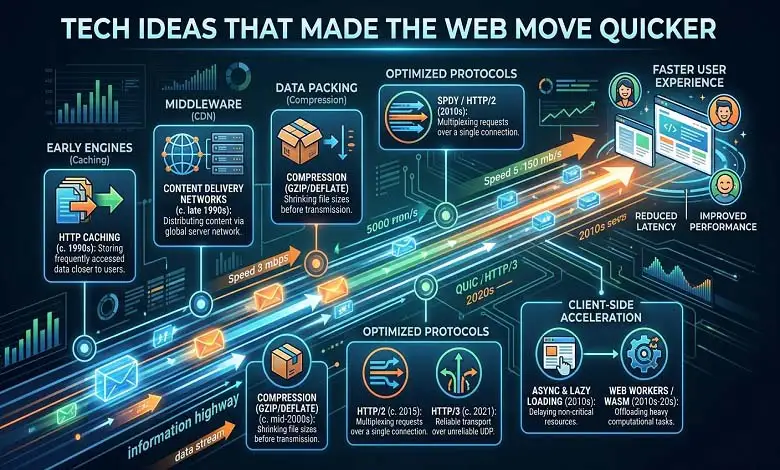
The internet has changed dramatically over the last few decades. What once felt slow, limited, and difficult to access has now become fast, intelligent, and available almost everywhere. Many innovative technologies and digital breakthroughs have helped improve how people browse websites, stream videos, play games, work remotely, and communicate online. These tech ideas that made the web move quicker and smarter continue to shape modern life and create better online experiences for billions of users worldwide.
From faster internet connections to artificial intelligence and cloud computing, the evolution of the web has been powered by smart solutions designed to increase speed, reduce delays, and improve efficiency. Today, users expect instant loading pages, high-quality streaming, and real-time communication, all made possible by technological innovation.
In the beginning, internet connections were extremely slow. Dial-up connections used telephone lines and often took several minutes to load a single webpage. Downloading files was frustrating, and streaming videos was nearly impossible. Webpages were also simple because internet speeds could not support heavy graphics or interactive content.
As more people started using the internet, companies and developers searched for new ways to improve speed and reliability. This led to some of the most important tech ideas that made the web move quicker and smarter.
One of the biggest technological improvements was the introduction of broadband internet. Unlike dial-up, broadband offered continuous high-speed internet access. This allowed users to browse websites faster, watch videos smoothly, and download files in much less time.
Broadband technology helped businesses grow online and made digital communication easier. It also supported the rise of streaming services, online gaming, and cloud-based applications. Faster internet connections created a foundation for a smarter web experience.
Fibre optic cables became another breakthrough. Instead of sending data through traditional copper wires, fibre optics uses light signals to transfer information at extremely high speeds.
This technology significantly reduced latency and improved internet performance. Today, many countries rely on fibre optic networks to provide ultra-fast internet for homes and businesses. Fibre optics made the web quicker by supporting large amounts of data traffic without slowing down.
Wireless internet technology transformed how people connect to the web. Before Wi-Fi became common, users depended on wired connections that limited mobility. Wi-Fi allowed laptops, smartphones, and smart devices to connect wirelessly from almost anywhere.
Public Wi-Fi networks in cafes, airports, schools, and offices made internet access more convenient. This innovation also supported the growth of mobile devices and smart homes.
The rise of smartphones completely changed internet usage. Mobile internet technology, including 3G, 4G, and now 5G networks, helped users access information instantly while travelling or working remotely.
Modern smartphones combine fast processors, powerful apps, and high-speed internet connectivity. Mobile technology made the web smarter by bringing online services directly into people’s pockets.
5G technology is one of the newest tech ideas that made the web move quicker and smarter. Compared to previous mobile networks, 5G offers:
- Faster download speeds
- Lower latency
- Better support for connected devices
- Improved streaming quality
- Faster cloud gaming experiences
This technology is helping industries develop smart cities, self-driving cars, and advanced communication systems.
Cloud computing changed how data is stored and managed. Instead of relying only on physical computers or local servers, businesses now use cloud platforms to store files and run applications online.
Cloud services allow websites and apps to load faster because resources can be distributed across multiple global servers. Companies can also scale their systems more efficiently during high traffic periods.
Cloud computing made the web smarter by improving collaboration, storage, and accessibility.
Content Delivery Networks, often called CDNs, are another major innovation. A CDN stores copies of website content on servers located around the world.
When users visit a website, the CDN delivers content from the server closest to their location. This reduces loading time and improves browsing speed.
Popular streaming platforms and major websites rely heavily on CDNs to ensure smooth performance for millions of users at the same time.
Artificial intelligence has transformed the internet in many ways. AI systems can analyze data, understand user behaviour, and provide personalized experiences.
Today, AI powers:
- Search engine recommendations
- Chatbots and virtual assistants
- Smart advertising
- Fraud detection systems
- Voice recognition tools
- Automated customer support
AI helps websites operate more efficiently and gives users faster access to relevant information.
Search engines have evolved significantly over time. Early search engines mainly relied on simple keyword matching. Modern search engines now use advanced algorithms and AI to understand user intent.
This means users can find better results more quickly. Intelligent search systems save time and improve the overall browsing experience.
Voice search technology has also made searching more convenient by allowing users to ask questions naturally instead of typing.
Developers have created many techniques to make websites faster and smarter. Website optimization includes:
- Compressing images
- Reducing unnecessary code
- Using browser caching
- Optimizing databases
- Improving server response times
These improvements reduce page loading speed and create smoother browsing experiences for users.
Modern websites are designed to work efficiently across desktops, tablets, and smartphones.
Streaming services became possible because of improvements in internet infrastructure and video compression technology. Platforms can now deliver high-definition movies, music, and live events without requiring users to download large files first.
Adaptive streaming technology automatically adjusts video quality based on internet speed. This prevents buffering and improves viewing experiences.
Streaming technology made the web smarter by allowing instant access to entertainment from almost anywhere.
Modern web browsers are much more advanced than earlier versions. Browsers now focus heavily on speed, security, and compatibility.
Features such as tab management, password protection, ad blocking, and hardware acceleration help users browse more efficiently. Browsers also support advanced web applications that function almost like desktop software.
Security improvements help protect users from online threats and cyberattacks.
Algorithms play a major role in how the modern internet works. Social media platforms, video streaming services, and online stores use algorithms to personalize content for each user.
These smart systems analyze browsing behaviour and preferences to recommend videos, products, news, and social media posts.
Although algorithms improve convenience, they also raise important discussions about privacy and digital responsibility.
The Internet of Things, commonly called IoT, connects smart devices through the internet. Examples include:
- Smart TVs
- Smart speakers
- Security cameras
- Fitness trackers
- Smart thermostats
These connected devices communicate and share data automatically. IoT technology makes homes and workplaces more efficient and intelligent.
As the internet became faster and more connected, cybersecurity became increasingly important. Developers introduced encryption technologies, secure payment systems, and multi-factor authentication to protect users online.
Modern cybersecurity tools use AI and machine learning to detect suspicious activities and prevent cyber threats in real time.
A safer internet allows users to browse, shop, and communicate with greater confidence.
Edge computing is another smart technology improving internet performance. Instead of processing all data in distant cloud servers, edge computing handles some tasks closer to the user’s location.
This reduces delays and improves real-time applications like online gaming, video conferencing, and smart devices.
Edge computing is especially important for industries that require fast data processing and instant responses.
Open source software allowed developers around the world to collaborate and improve technologies together. Many important web technologies rely on open source systems, including web servers, programming frameworks, and operating systems.
This collaborative approach accelerated innovation and helped businesses create faster, smarter digital services.
The impact of these technologies can be seen everywhere. Faster and smarter internet systems have transformed:
- Education through online learning
- Healthcare through telemedicine
- Business through remote work
- Banking through digital payments
- Shopping through e-commerce
- Entertainment through streaming services
People can now connect globally within seconds and access massive amounts of information instantly.
The future internet will likely become even more advanced. Emerging technologies such as quantum computing, advanced AI, and satellite internet networks may continue improving speed and accessibility.
Developers are also working on smarter automation systems, better cybersecurity solutions, and more energy-efficient networks.
As technology evolves, the web will continue becoming faster, more intelligent, and more integrated into daily life.
The internet has come a long way from its slow and limited beginnings. Many groundbreaking innovations have contributed to the development of a faster and more intelligent online world. Broadband, fibre optics, smartphones, cloud computing, AI, CDNs, and 5G are just some of the 8 tech ideas that made the web move quicker and smarter.
These technologies continue to improve communication, entertainment, business, and education while shaping the future of digital experiences. As innovation continues, the web will likely become even more powerful, efficient, and accessible for future generations.
A. Broadband internet, fibre optics, cloud computing, AI, CDNs, and 5G networks are some of the major technologies that have improved web speed and intelligence.
A. Broadband provided faster and continuous internet access compared to slow dial-up connections.
A. Cloud computing improves website performance, data storage, and online collaboration while supporting scalable digital services.
A. AI helps personalize search results, automate tasks, improve recommendations, and enhance customer support systems.
A. 5G offers higher speeds, lower latency, and better connectivity for mobile devices and smart technologies.
[…] Automation tools reduce manual work. They’re efficient and scalable. But when something goes wrong, they don’t always explain why. […]