
 By Bapi Mondal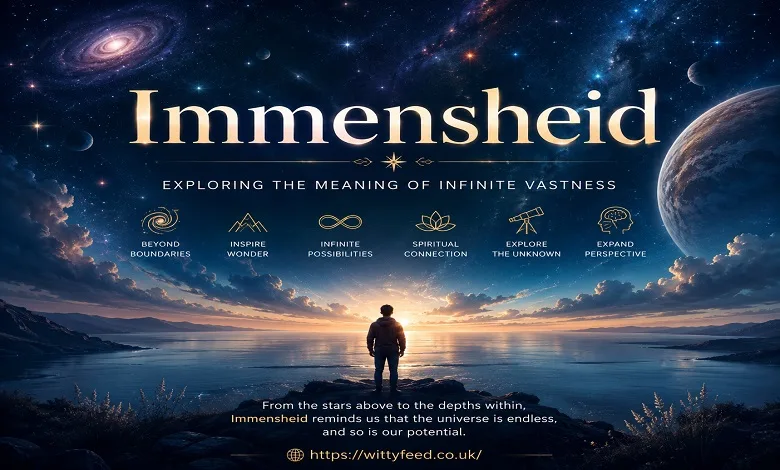
The word Immensheid carries a deep and fascinating meaning that connects with ideas of endless space, limitless imagination, and the overwhelming scale of existence. Although not commonly used in everyday conversation, the term has gained attention among people interested in philosophy, art, spirituality, and the mysteries of the universe. Immensheid represents more than physical size. It symbolizes the feeling of standing before something so vast that it exceeds normal human understanding.
From the endless sky above us to the depths of human thought, the idea of Immensheid appears in many aspects of life. People experience it while watching the ocean, exploring outer space, or reflecting on the complexity of the universe. The concept encourages curiosity, wonder, and a deeper appreciation of existence itself.
In this article, we will explore the meaning of Immensheid, its origins, symbolic interpretations, philosophical relevance, artistic influence, and its role in modern culture.
Immensheid can be understood as the experience or quality of infinite vastness. The term reflects the idea of something immeasurable, boundless, and beyond ordinary limits. It is often associated with feelings of awe because the human mind naturally struggles to fully comprehend infinity.
The concept is closely connected with words such as:
- Vastness
- Infinity
- Boundlessness
- Limitlessness
- Cosmic scale
- Endless possibility
When people encounter Immensheid, they often feel both inspired and humbled at the same time. This emotional response happens because immense things remind humans of how small they are within a much larger universe.
The word Immensheid appears to have roots connected to European linguistic traditions where terms related to “immense” describe extraordinary size or greatness. The suffix often implies a state or condition, making the word represent the condition of being immeasurably vast.
Across different languages and cultures, similar concepts exist to describe infinity and endlessness. Ancient civilizations looked at the stars and tried to explain the enormous universe surrounding them. Philosophers, poets, and scientists have long attempted to describe experiences that feel larger than human understanding.
Even though terminology differs, the emotional reaction remains similar. Humans are naturally fascinated by things that seem infinite.
The fascination with Immensheid comes from a basic part of human psychology. People are naturally curious about the unknown. Large landscapes, deep oceans, endless deserts, and outer space all create feelings of mystery.
There are several reasons why immense things attract attention:
Immense environments trigger amazement. Looking at a galaxy-filled night sky often creates emotional reactions because it reminds people of the scale of existence.
Many people connect vastness with deeper philosophical questions. They begin thinking about life, time, purpose, and humanity’s place in the universe.
Experiencing vastness can help people temporarily forget everyday stress. Nature often creates peaceful feelings because it feels larger and more permanent than daily problems.
Artists, musicians, and writers often draw inspiration from immense landscapes and cosmic themes. Vastness encourages imagination and creativity.
Philosophy has explored concepts similar to Immensheid for thousands of years. Thinkers from different cultures examined infinity, existence, and the limits of human understanding.
Ancient philosophers debated whether the universe had boundaries. Some believed existence was endless, while others thought the cosmos had a defined structure.
Modern philosophy continues to examine these ideas. Questions about infinite space, time, and consciousness remain important topics.
Immensheid also highlights the limitations of human perception. Humans can only observe a small portion of reality. This realization often leads to humility.
Philosophers frequently discuss how people react emotionally when confronting something too vast to fully understand.
The idea of the “sublime” closely relates to Immensheid. The sublime refers to experiences that are both beautiful and overwhelming. Massive mountains, violent storms, or the endless universe can produce this emotional effect.
The sublime combines fear, admiration, wonder, and fascination into a single powerful experience.
One of the strongest examples of Immensheid is the universe itself. Modern astronomy has revealed scales that are almost impossible for humans to imagine.
Scientists estimate that the observable universe contains billions of galaxies. Each galaxy contains billions of stars. The distances between these objects are measured in light-years, which represent the distance light travels in a year.
The sheer scale of space creates a perfect example of infinite vastness.
Black holes represent another symbol of Immensheid. These mysterious objects possess gravitational forces so powerful that even light cannot escape.
Their existence challenges human understanding of physics and reality.
Modern science suggests that the universe continues expanding. This idea adds another layer to Immensheid because it implies that space itself may have no true limit.
The thought of endless cosmic expansion fascinates both scientists and philosophers alike.
Nature constantly presents examples of immense beauty and scale. Many people experience powerful emotions when surrounded by natural environments.
Standing beside the ocean often creates feelings of infinity. The endless horizon and deep waters symbolize mystery and vastness.
Massive mountain ranges remind people of nature’s strength and permanence. Their scale can feel overwhelming yet inspiring.
Deserts create a sense of endless openness. The absence of boundaries increases the emotional impact of vast landscapes.
Perhaps the most universal experience of Immensheid comes from looking at the stars. Ancient humans and modern societies alike continue feeling awe beneath the night sky.
Artists throughout history have attempted to capture immense feelings in paintings, music, literature, and film.
Painting: Landscape painters often use scale to create emotional impact. Large skies, distant horizons, and dramatic scenery help viewers feel the power of vastness.
Literature: Writers use descriptive language to express infinity and mystery. Science fiction especially explores themes connected to cosmic Immensheid.
Music: Music can also create feelings of endlessness. Slow orchestral compositions, atmospheric sounds, and emotional melodies often produce immersive experiences.
Cinema: Modern films frequently use space exploration and large-scale visuals to communicate Immensheid. Massive cosmic scenes create emotional reactions in audiences.
Many spiritual traditions connect Immensheid with divine or transcendent experiences. The infinite nature of existence often becomes linked with spirituality.
Infinite Creation: Some religions describe creation as boundless and eternal. Vastness becomes a symbol of divine power.
Meditation and Reflection: Meditation practices often encourage people to think beyond individual identity and connect with something larger than themselves.
Human Smallness: Spiritual traditions frequently emphasize humility when facing the immense scale of existence.
Experiencing immense environments can influence mental and emotional states.
Reduced Stress: Natural vastness sometimes helps people feel calmer. Large open spaces can reduce mental pressure and create emotional balance.
Increased Perspective: When people encounter immense environments, personal worries may temporarily feel smaller.
Curiosity and Exploration: Immensheid encourages exploration and learning. Humans naturally want to understand what lies beyond known boundaries.
The concept of Immensheid has become increasingly relevant in the digital era. Technology allows humans to explore enormous amounts of information and virtual experiences.
Digital Universes: Video games and virtual reality often create expansive worlds designed to inspire awe and exploration.
Online Knowledge: The internet itself reflects a kind of informational vastness. The endless flow of knowledge can feel overwhelming yet exciting.
Artificial Intelligence: AI systems capable of processing enormous datasets also represent a form of intellectual Immensheid. They reveal how technology continues expanding human capabilities.
One reason Immensheid remains meaningful is its emotional impact. Vast experiences affect people deeply because they challenge ordinary perception.
Common emotional responses include:
- Awe
- Wonder
- Humility
- Curiosity
- Inspiration
- Fear of the unknown
- Peacefulness
These emotions often appear together when humans encounter something larger than themselves.
Creative individuals frequently draw inspiration from infinite ideas and immense imagery.
Writers: Authors use themes of endlessness to explore philosophical and emotional questions.
Designers: Modern visual design often incorporates minimalism and expansive spaces to create immersive feelings.
Scientists: Scientific curiosity itself is fueled by Immensheid. Questions about the universe drive discovery and innovation.
Musicians: Many composers attempt to create soundscapes that feel endless and atmospheric.
Scientific exploration constantly reveals new forms of vastness.
Astronomy: Space research continues uncovering galaxies, planets, and cosmic structures beyond previous imagination.
Ocean Exploration: Large portions of Earth’s oceans remain unexplored, adding mystery to our own planet.
Quantum Reality: At microscopic scales, scientists also encounter immense complexity. Even tiny particles reveal realities difficult to fully understand.
One of the biggest questions connected to Immensheid is whether humans can genuinely understand infinity.
Mathematics allows infinite concepts to be studied logically, yet emotionally and physically, infinity remains difficult to imagine.
Humans are finite beings trying to understand limitless existence. This challenge may explain why Immensheid feels so mysterious and emotionally powerful.
Many people experience personal growth through encounters with vastness. Watching a sunset over the ocean or observing stars in silence can inspire reflection about life and purpose.
These moments encourage individuals to:
- Appreciate existence
- Reflect on priorities
- Feel connected to nature
- Explore philosophical questions
- Develop humility
Immensheid therefore becomes more than a concept. It becomes an emotional and personal experience.
As technology advances, humanity continues moving deeper into immense frontiers.
Future possibilities include:
- Deep space travel
- Exploration of distant planets
- Advanced virtual worlds
- Greater understanding of consciousness
- Discovery of unknown cosmic phenomena
Every new discovery expands humanity’s understanding of vastness.
Immensheid represents the powerful idea of infinite vastness and boundless existence. It appears in philosophy, science, nature, art, spirituality, and human emotion. Whether experienced through the stars above, the ocean horizon, or deep personal reflection, Immensheid reminds humanity that existence is far larger and more mysterious than everyday life suggests.
The concept continues inspiring curiosity, creativity, and exploration because humans are naturally drawn toward the unknown. Vastness challenges perception, encourages humility, and awakens wonder. In a world filled with limitations, Immensheid offers a glimpse into something limitless.
As humanity continues exploring both the universe and the depths of human thought, the meaning of Immensheid will likely remain an enduring symbol of awe, mystery, and infinite possibility.